Vienna
I go to Vienna for conferences, for the airport and, more and more often, just because — for the schnitzel, the Kaiserschmarrn and the wine that grows inside the city. What I have managed to see over the years, where to eat well and why a non-coffee-drinker orders coffee there.
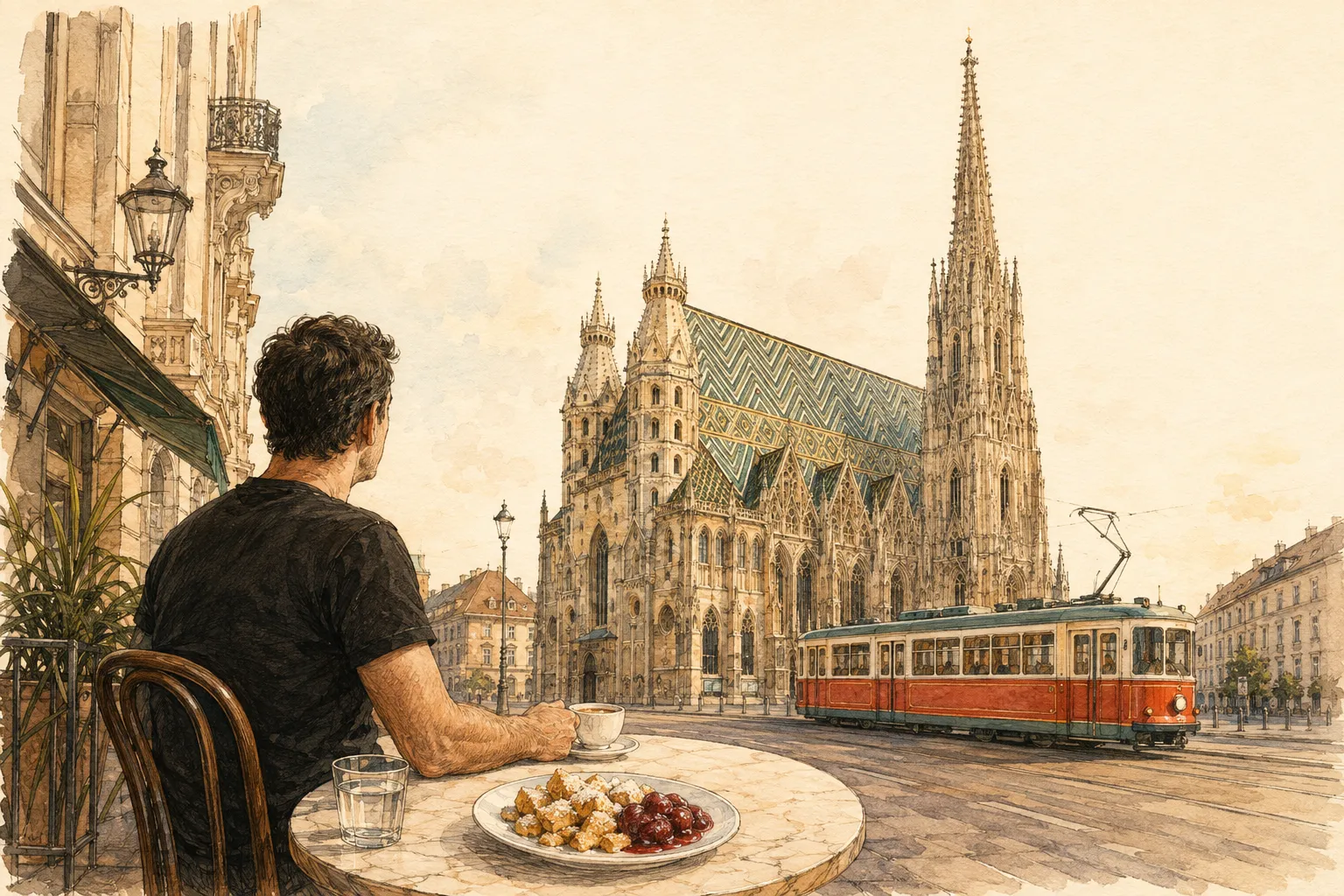
Vienna breathes monarchy. Sisi, Maria Theresa, Wiener Schnitzel, Tafelspitz and Kaiserschmarrn — plus proper wine that grows right inside the “city”. It is a busy place, but clean and with services that simply work. That is not just my impression — Vienna topped the Mercer quality-of-living ranking ten years in a row. Expensive, but that comes with the territory. And one more thing: I do not drink coffee, but here I always order one. The air smells of classical music, sweet apple strudel and a nostalgia that does not weigh on you but gently wraps around you. Vienna is not just a place on the map. It is a melancholy waltz that keeps dancing inside you long after the lights of the opera go out.
How many times, and why
Vienna is the nearest big city with an imperial past to Žilina, so I keep going back. My diaries hold four documented trips: May 2018, November 2019, December 2022 (the spa town of Baden with day trips into Vienna) and, most recently, three days at the turn of August and September 2026. Add to that countless drives to the airport — flights from Bratislava are limited, so whoever flies, flies from Schwechat. This entry sums up all of those trips and it will keep growing. The list of places I want to return to is longer than the list I have ticked off.
Where I have taken photos over the years, a map shows best: the centre glows the most, Klosterneuburg in the north and Schönbrunn in the south-west are separate blobs, and the small one at Heiligenstadt is a Heuriger.
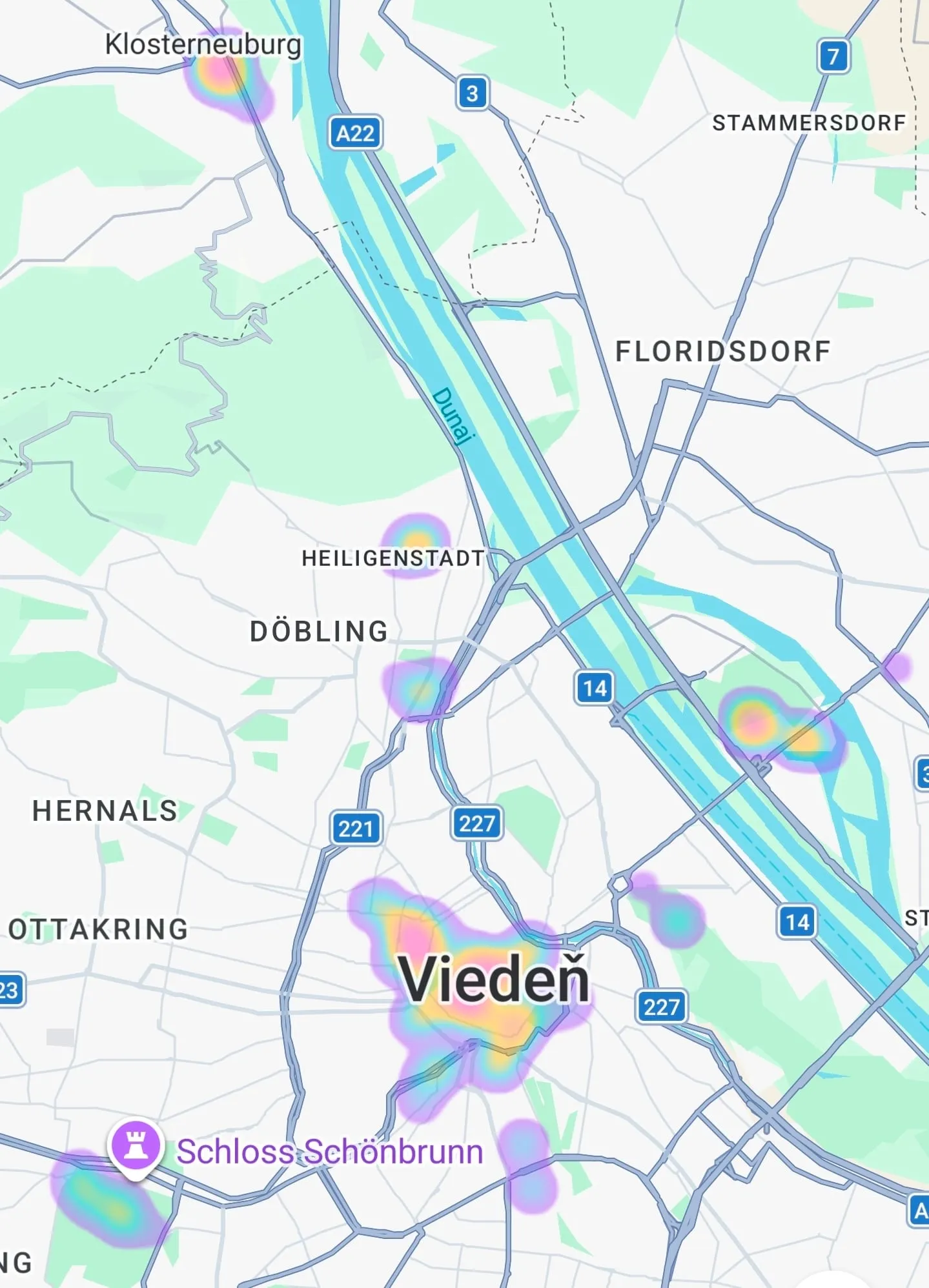
Where the photos from all the trips were taken. Map: Google Photos.
Work footprint
I used to go to Vienna for the WeAreDevelopers conference while it was held there — in 2017 and 2018 — before it moved to Berlin. In 2026 I was in Vienna for the conference on economics, finance and business organised by the IISES institute (programme).
My top 10
The order is subjective and complaints are not accepted :)
- Demel — watching the top dessert being made live is worth it.
- Mayer am Pfarrplatz — dinner in the garden is the perfect way to unwind, any time.
- Rathauspark — a compulsory stop, above all during the Christmas market.
- St. Stephen’s Cathedral — do not forget to take the lift up the tower, to the big bell and the view.
- Karlskirche — the evening concert has atmosphere.
- Schönbrunn — an escape into the gardens from the bustle of the city.
- Naschmarkt — an unusual, elongated market squeezed between two streets.
- Julius Meinl — this is what a grocery store should look like.
- Klosterneuburg — if you have more time, a full-day trip for wine, the biggest barrel and the monks.
- The Austrian Mint — a lot of gold in one place, and the maker of the world-famous Vienna Philharmonic coins.
The centre
The old town can be walked in a single line: from Josefsplatz via Michaelerplatz, Kohlmarkt and Graben to Stephansplatz, on to Fleischmarkt and then via Am Hof and Freyung to the city hall. On the way you pass the Hofburg at least from the outside, a handful of cafés that would deserve an entry of their own, and everything listed below.
St. Stephen’s Cathedral
The south tower of the cathedral is over 136 metres high and 343 steps lead up it. The north tower was never finished — it stops at 68 metres — and that is exactly why it has a lift. Up there hangs the Pummerin, Austria’s largest bell: it weighs over twenty tonnes, was cast in 1951 from the metal of an older bell from 1711, which had itself been cast from Turkish cannons after the siege of Vienna, and it has hung in the north tower since 1957. It rings only on special occasions, New Year’s Eve for one. My advice: do not forget to go up to the bell and the view. The lift is for the lazy and the wise. Leave the 343 steps to those who did not just eat at the Naschmarkt.
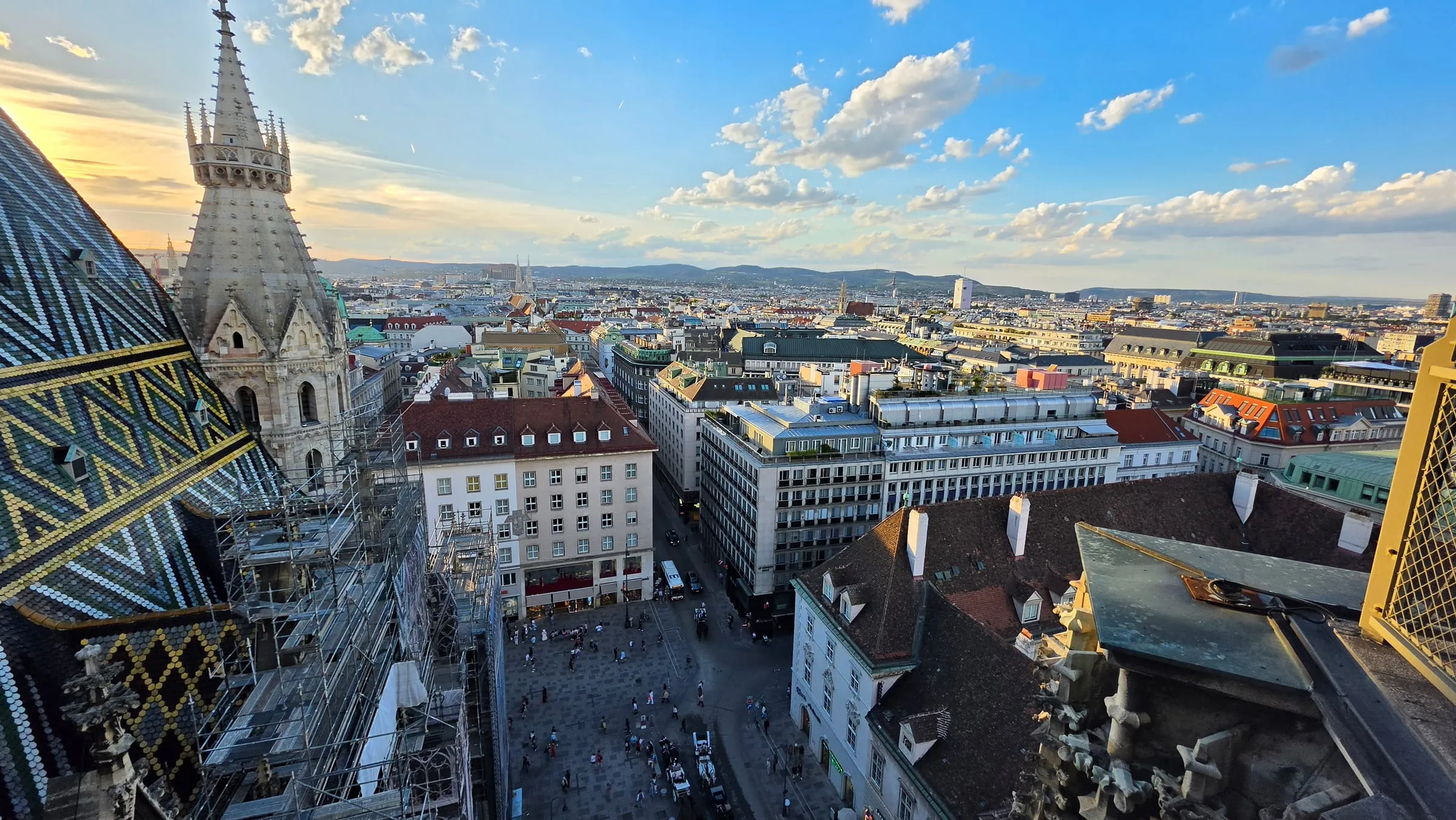
The view from the Pummerin. South tower on the left, all of Vienna on the right.
The State Hall of the Austrian National Library
The baroque hall on Josefsplatz was commissioned by Emperor Charles VI and built between 1723 and 1726 to plans by Johann Bernhard Fischer von Erlach, and his son finished it. It is almost eighty metres long, four Venetian globes stand under the frescoed dome and the shelves hold around two hundred thousand historic volumes. It is worth it for the bookcase that opens like a secret door alone. Anyone who grew up on Harry Potter knows.
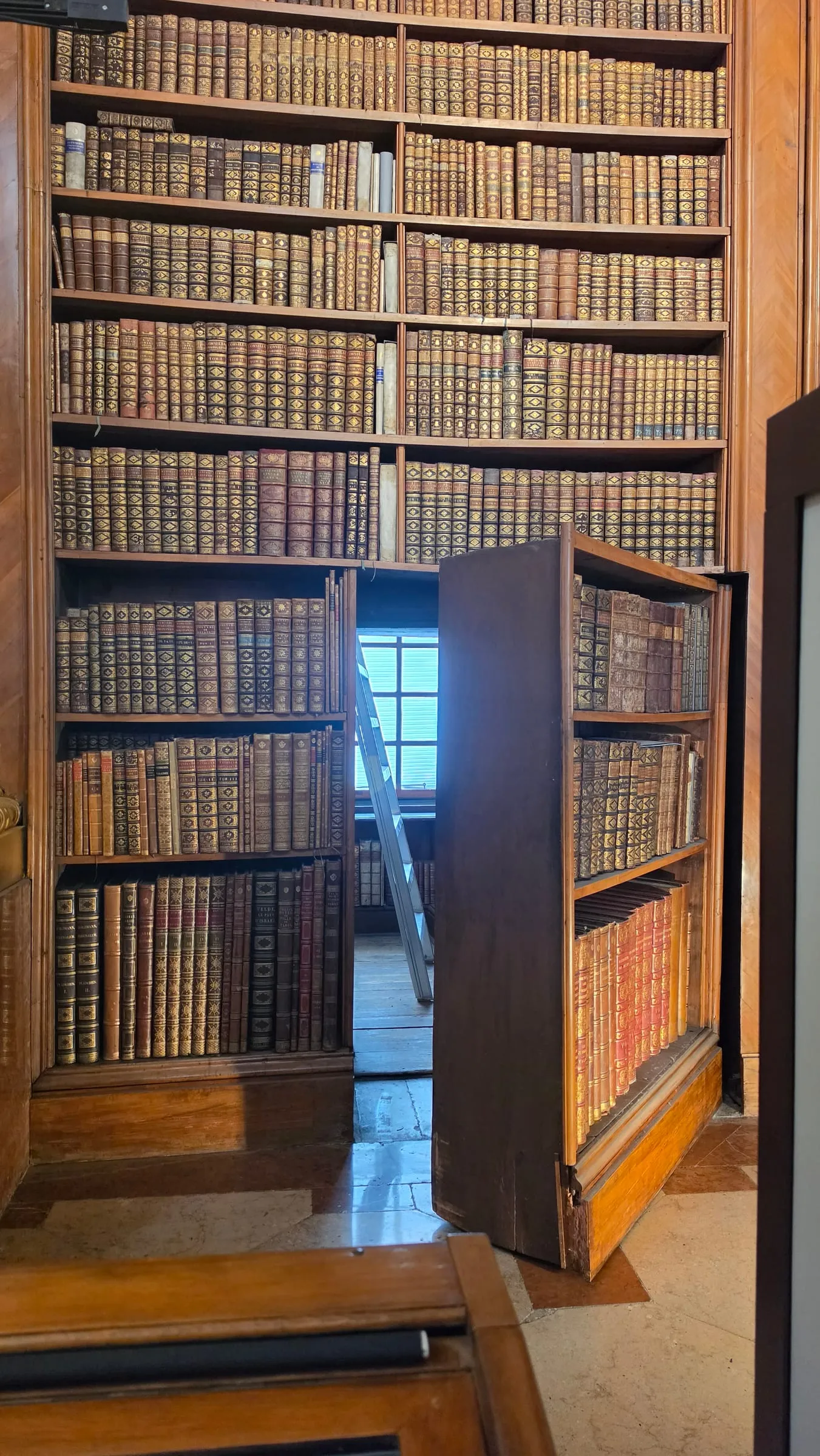
A bookcase that is also a door. Hogwarts had a model.
Karlskirche
Emperor Charles VI vowed to build the Church of St. Charles Borromeo during the plague of 1713. It went up between 1716 and 1737, again to Fischer von Erlach’s design, and the dome rises seventy metres. Inside, Orchester 1756 plays Vivaldi’s Four Seasons on period instruments. The evening concert has atmosphere — marble, frescoes, candlelight and baroque music sounding exactly where it belongs. We almost missed it because stories were being posted to Instagram on Karlsplatz. We made it.
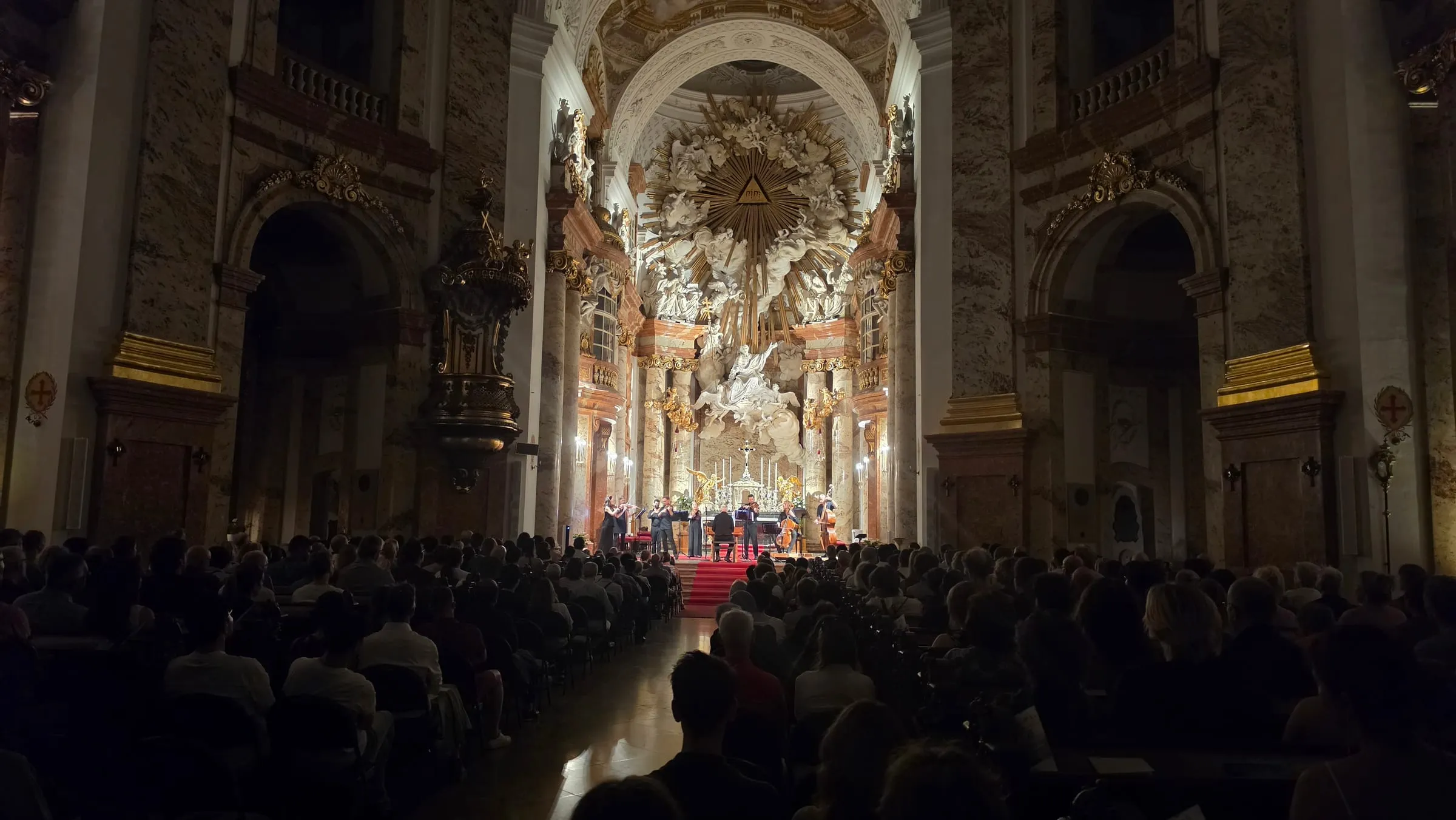
Vivaldi in the Karlskirche. Four seasons in one evening.
Rathausplatz
The park in front of the city hall lives all year, but two dates are compulsory. In December the Wiener Christkindlmarkt has stood here since 1975 — punch, roasted chestnuts and mugs that end up going home with you anyway. And in summer the square hosts a film festival: since 1991, every July and August evening, a free opera, concert or ballet on a big screen and dozens of food stalls around it. We got The Phantom of the Opera. The Christmas market is, for me, clearly the best reason to go to Vienna in winter.
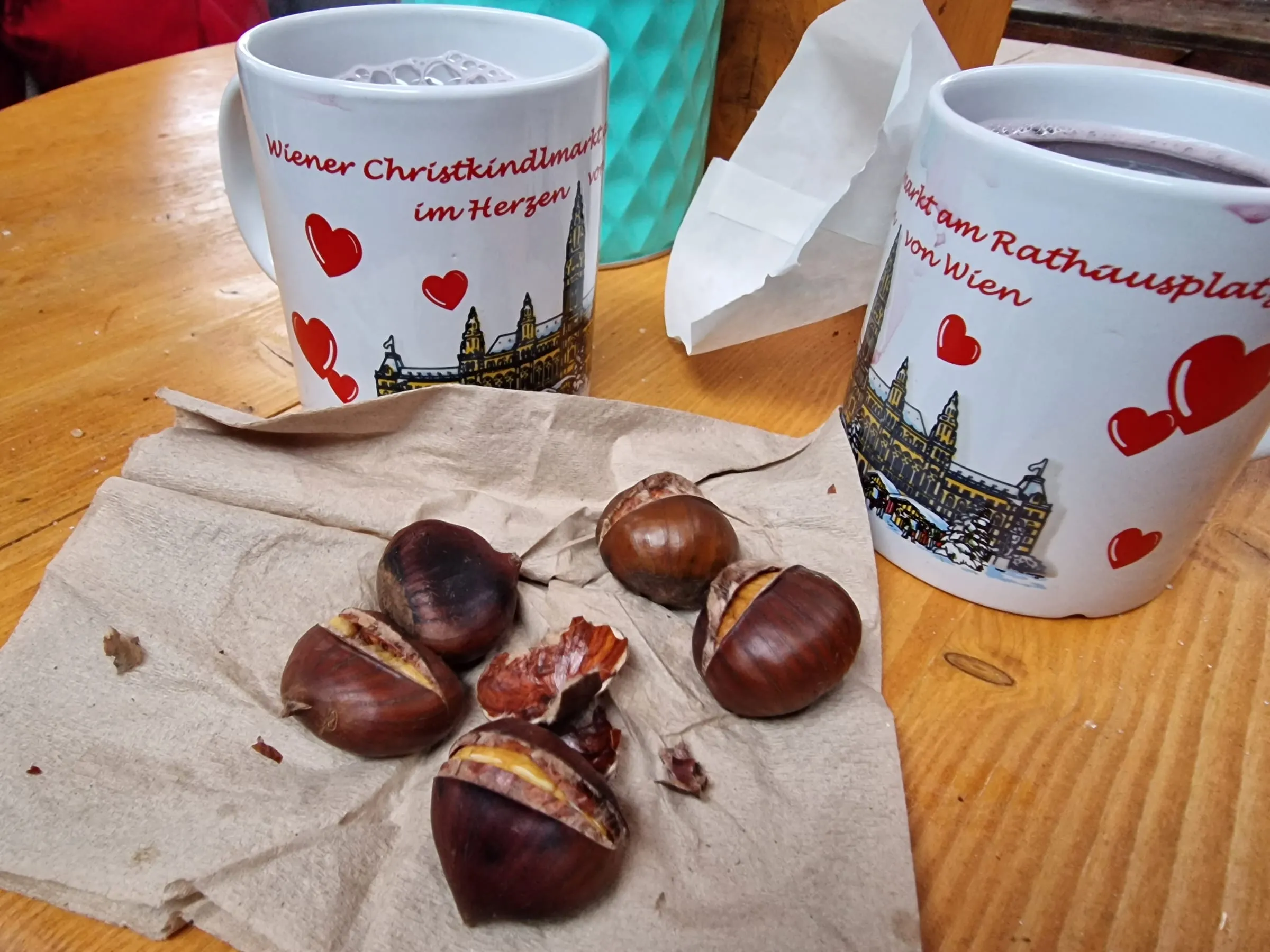
December 2022. Punch and chestnuts. The mugs went home.
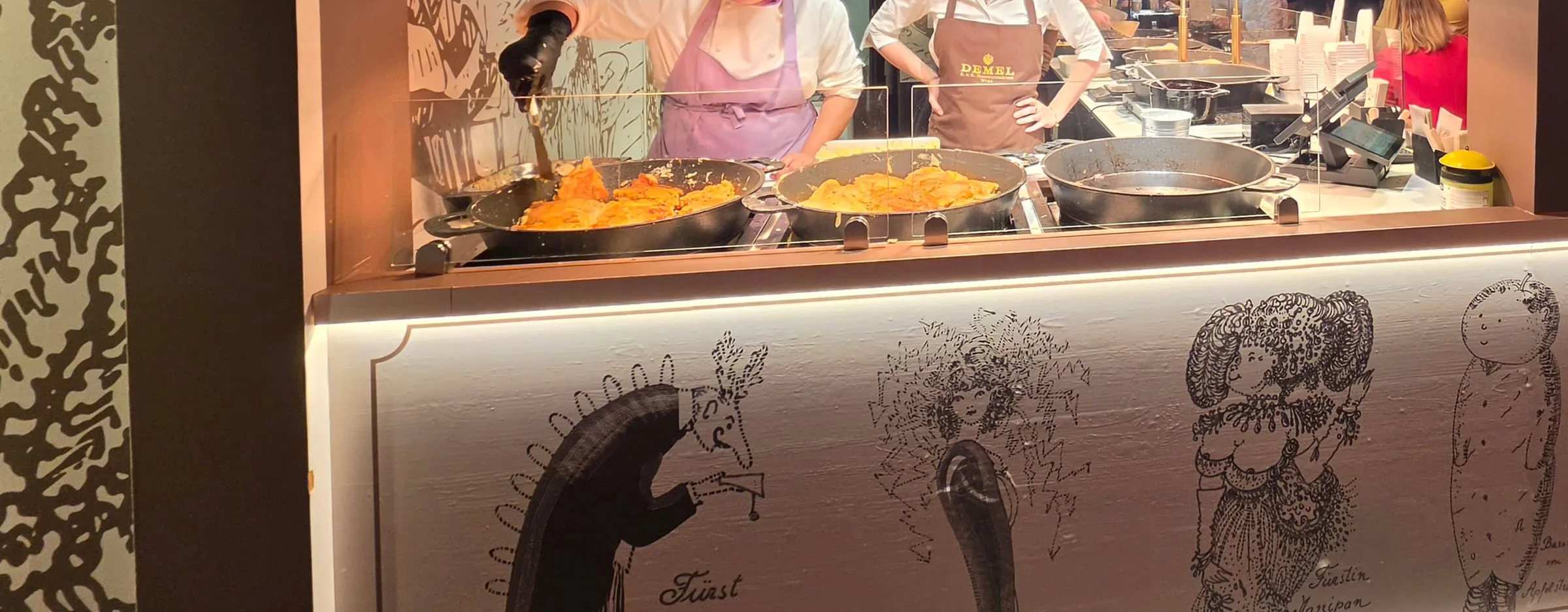
Film festival, September 2026. Demel makes Kaiserschmarrn live, the Phantom sings behind our backs.
Demel
Demel on Kohlmarkt has existed since 1786 and held the title of imperial and royal court confectioner. Kaiserschmarrn — literally “the emperor’s mess” — is said to be named after Emperor Franz Joseph I, who supposedly loved it. I had my first Kaiserschmarrn at Demel and it was the best by a mile. Every one since has only been compared to it. Tip: in the shop on Kohlmarkt go to the back — that is where they make it, and watching the top dessert being prepared live is worth it. Apple strudel with vanilla sauce is the compulsory side, even though I am not a sweets person. And they sell the Sachertorte under their own name: the dispute with Hotel Sacher over who has the original dragged on until 1963 and ended with an agreement that each has its own.
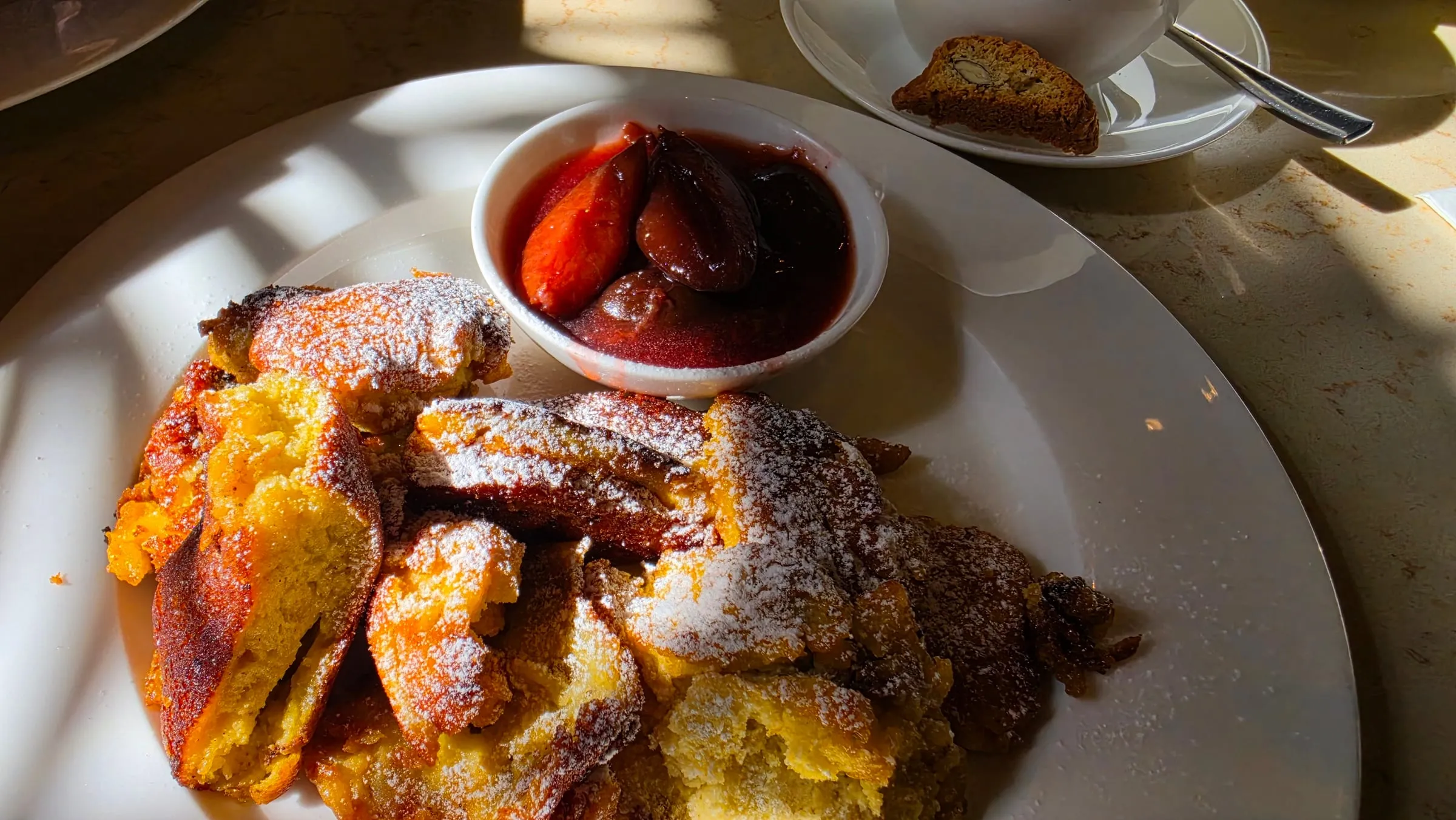
The first Kaiserschmarrn. Plum compote is part of the deal.
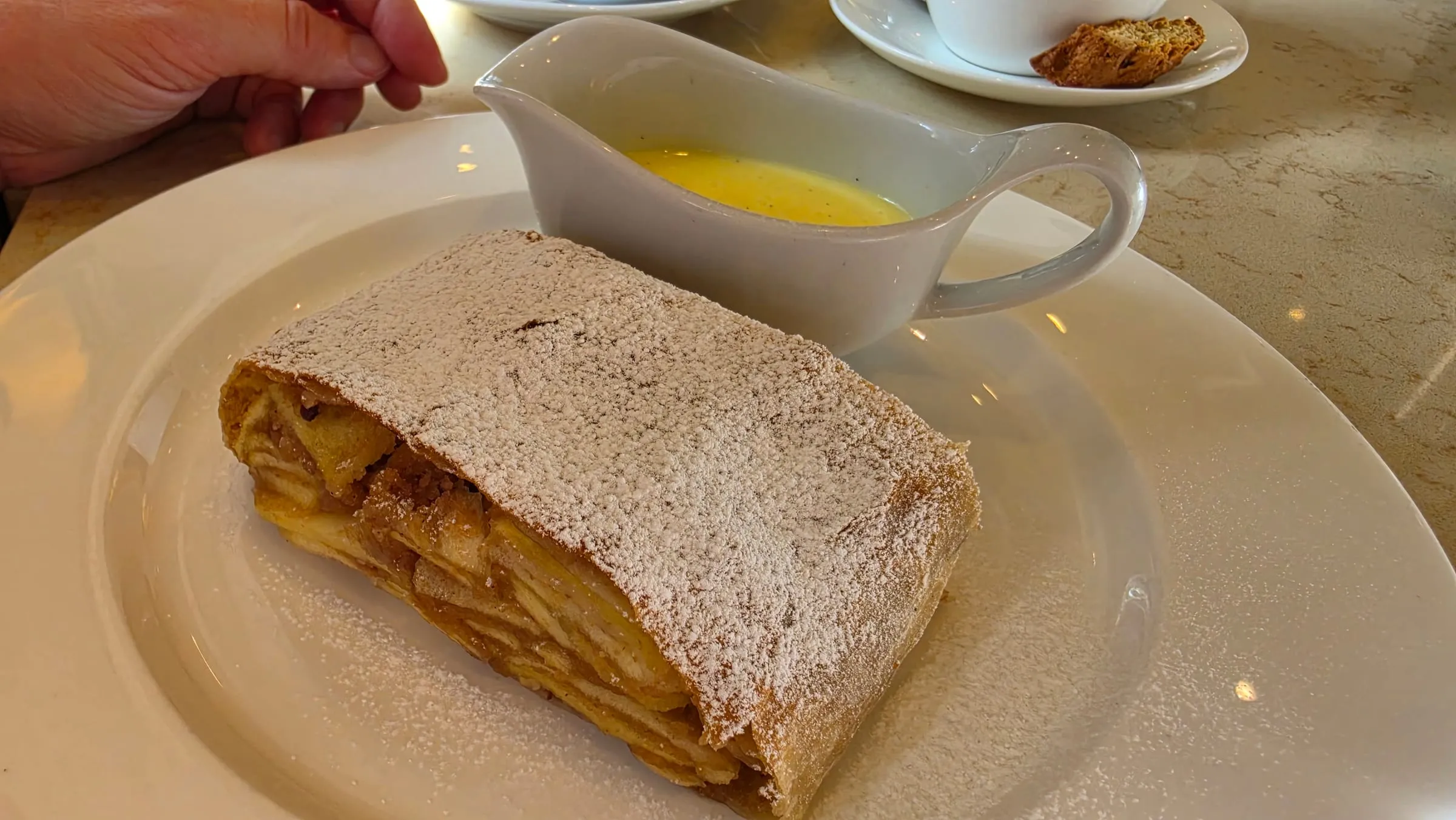
Apfelstrudel. The vanilla sauce is not optional.
Julius Meinl am Graben
The Julius Meinl company dates from 1862 and its flagship store at Graben 19, opened in 1950, is Vienna’s largest delicatessen: cheese, chocolate, coffee, wine, delicacies from all over the world. This is what a grocery store should look like. Perfection for food shopping — worth seeing even if you buy nothing. You will buy something.
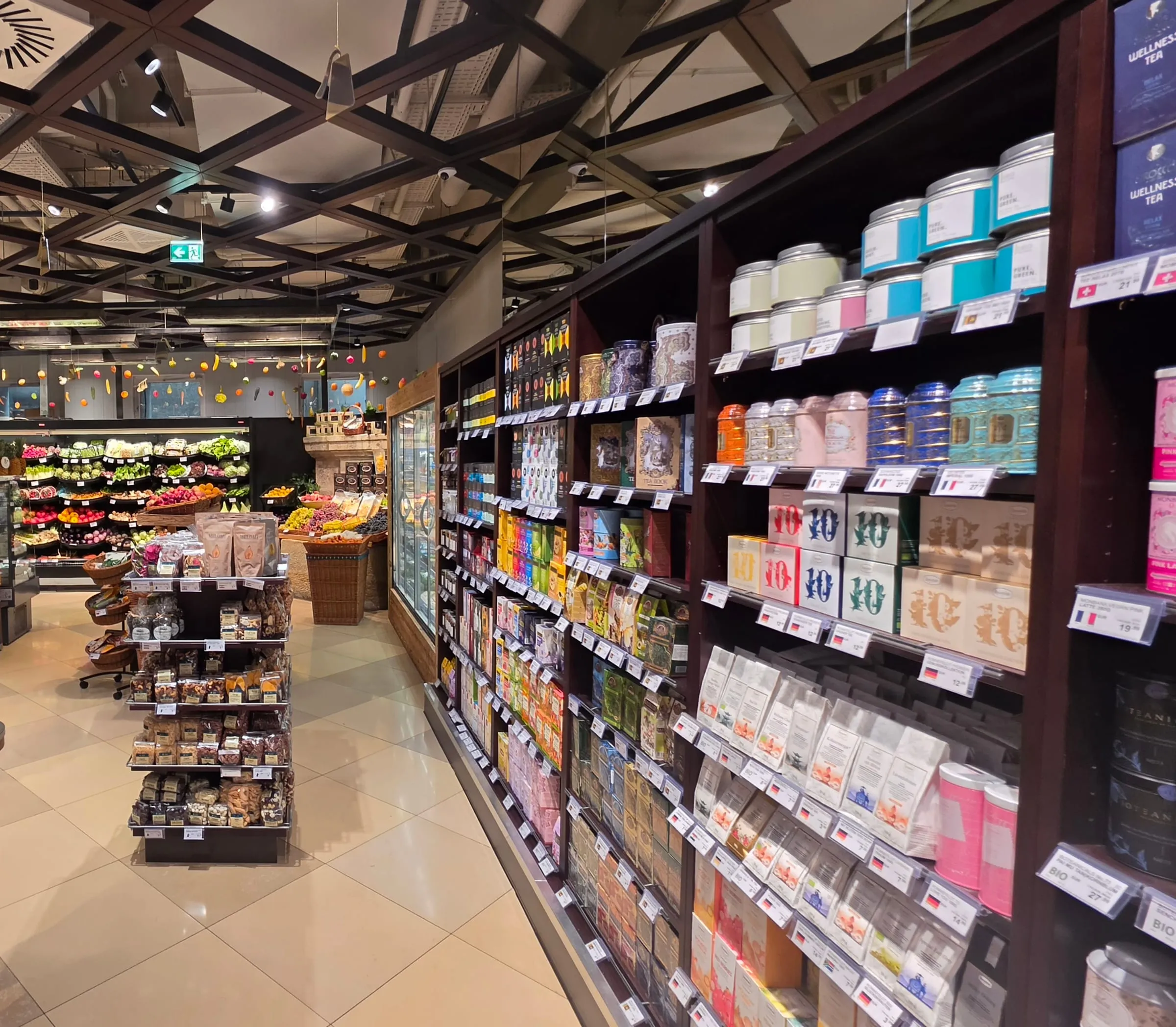
Meinl on the Graben. A grocery store you walk through slowly.
Naschmarkt
The Naschmarkt is an unusual, elongated market squeezed between two streets: it stretches for about a kilometre and a half between Linke and Rechte Wienzeile, above the vaulted-over river Wien. The market’s roots go back to the 16th century, it has stood on its present site since 1916 and has around 130 stalls. Fruit, cheese, spices, fish, stalls where you can sit down, and a flea market on Saturdays. We came here to buy Zotter chocolate — that is a must — even though the Leberkäse nearly seduced us.
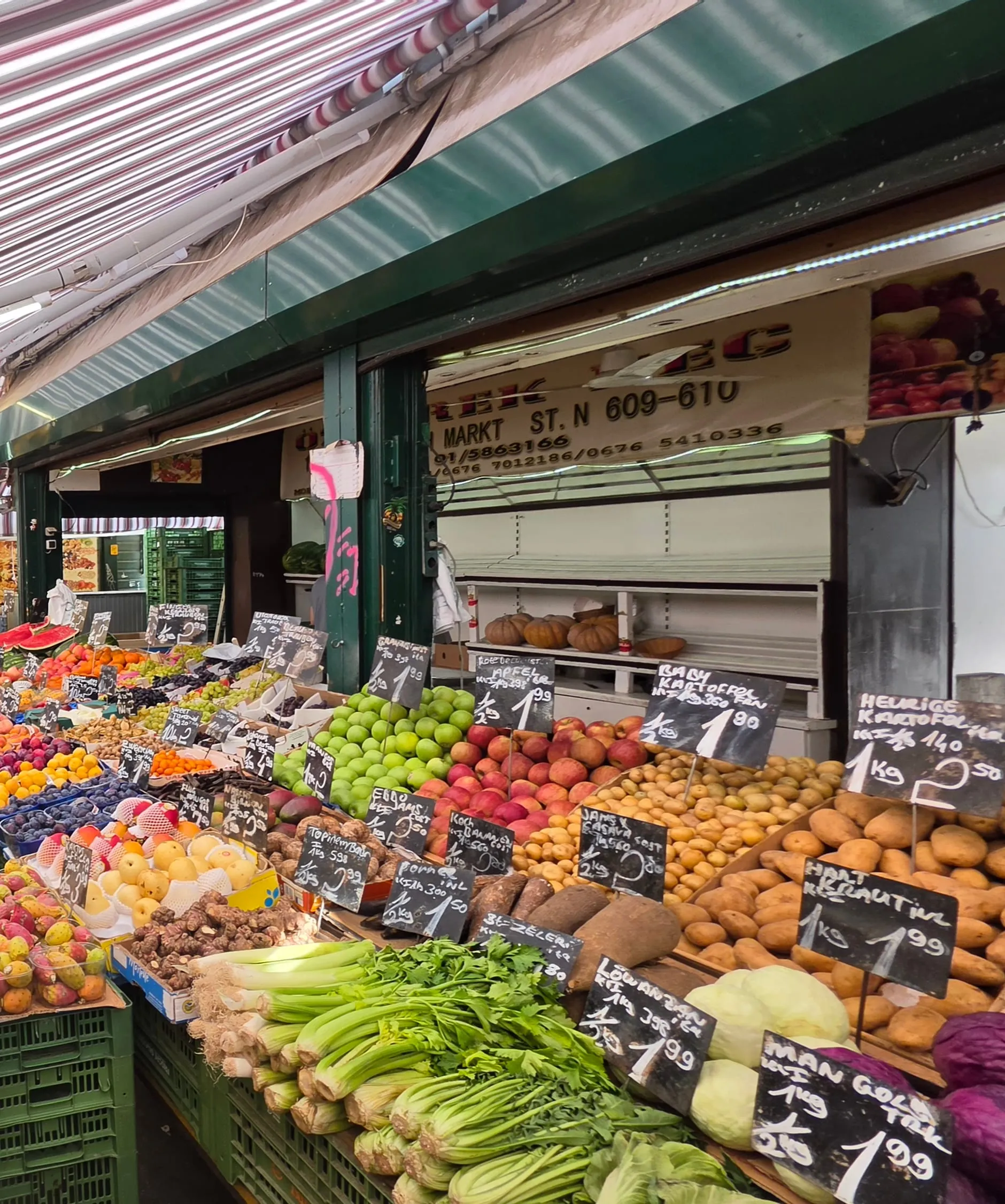
Naschmarkt. Handwritten price tags, as it should be.
The Austrian Mint
The Münze Österreich on Heumarkt has been striking coins since the Middle Ages — it traces its tradition to 1194, when Duke Leopold V had the first Viennese coins struck from the ransom paid for the English king Richard the Lionheart. Today it is the maker of the world-famous Vienna Philharmonic coins: the gold bullion coin has been issued since 1989, the silver one since 2008 and the platinum one since 2016. A lot of gold in one place. As someone who researches Bitcoin, I had to see it — you should know your competition.
Schönbrunn
The Habsburgs’ summer residence has 1,441 rooms, has been a UNESCO site since 1996 and the gardens are free. The Palm House from 1882 is 111 metres long, the maze goes back to 1720 and was restored in 1999, the Gloriette on the hill dates from 1775, the Neptune Fountain from 1780, the Roman Ruin from 1778 and the Obelisk from 1777 — Maria Theresa built at a pace no developer could manage today. For me, Schönbrunn is above all an escape into the gardens from the bustle of the city. The best view is from the Neptune Fountain back towards the palace. The Orangery was closed for an event, so we have a reason to come back.
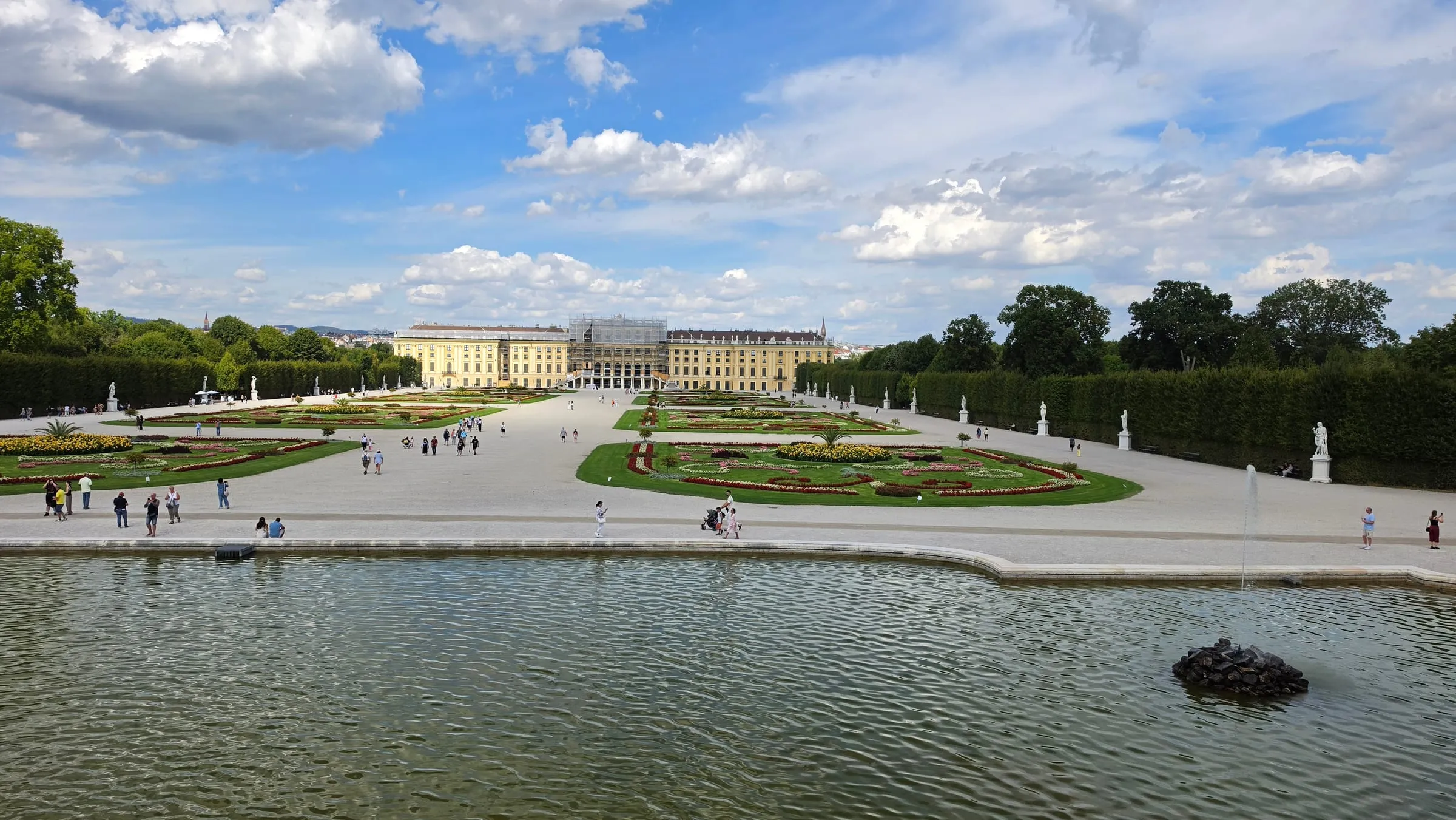
From the fountain to the palace. At that scale, people are correctly small.
Döbling — vineyards in the city
Vienna is the only European capital with serious wine-growing of its own: almost six hundred hectares of vineyards inside the city limits, mostly on the slopes of Döbling — Grinzing, Nussdorf, Heiligenstadt, Sievering. With the vineyards comes the Heuriger, a wine tavern where the winemaker pours their own young wine (a right granted by decree of Joseph II in 1784). That it is open is traditionally announced by a bunch of pine branches hung above the door. We stayed right in this district, with the wine country just outside the windows, and walked through Grinzing after dark on the very first evening.
Mayer am Pfarrplatz
The Heuriger Mayer am Pfarrplatz in Heiligenstadt sits in the house where Beethoven lived in 1817. For me the top Heuriger and a perfect space: dinner in the garden is the perfect way to unwind, any time. A board of hams, a pickle, cheese and spreads, a bowl of soup, a glass of red and a glass of sparkling. And a quote on the menu that I had to photograph.
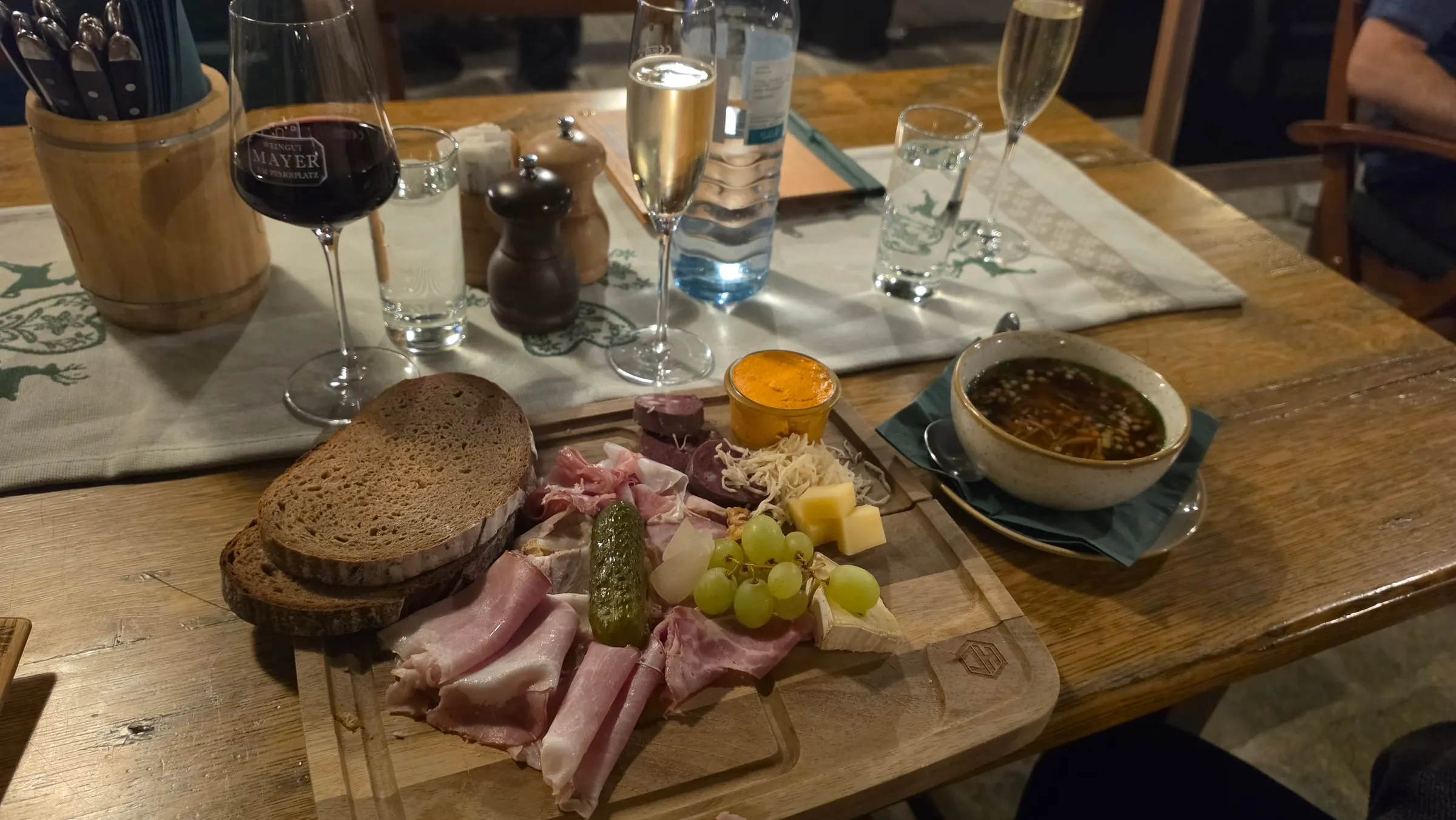
A Heuriger in short: wine, ham, bread, nothing extra.
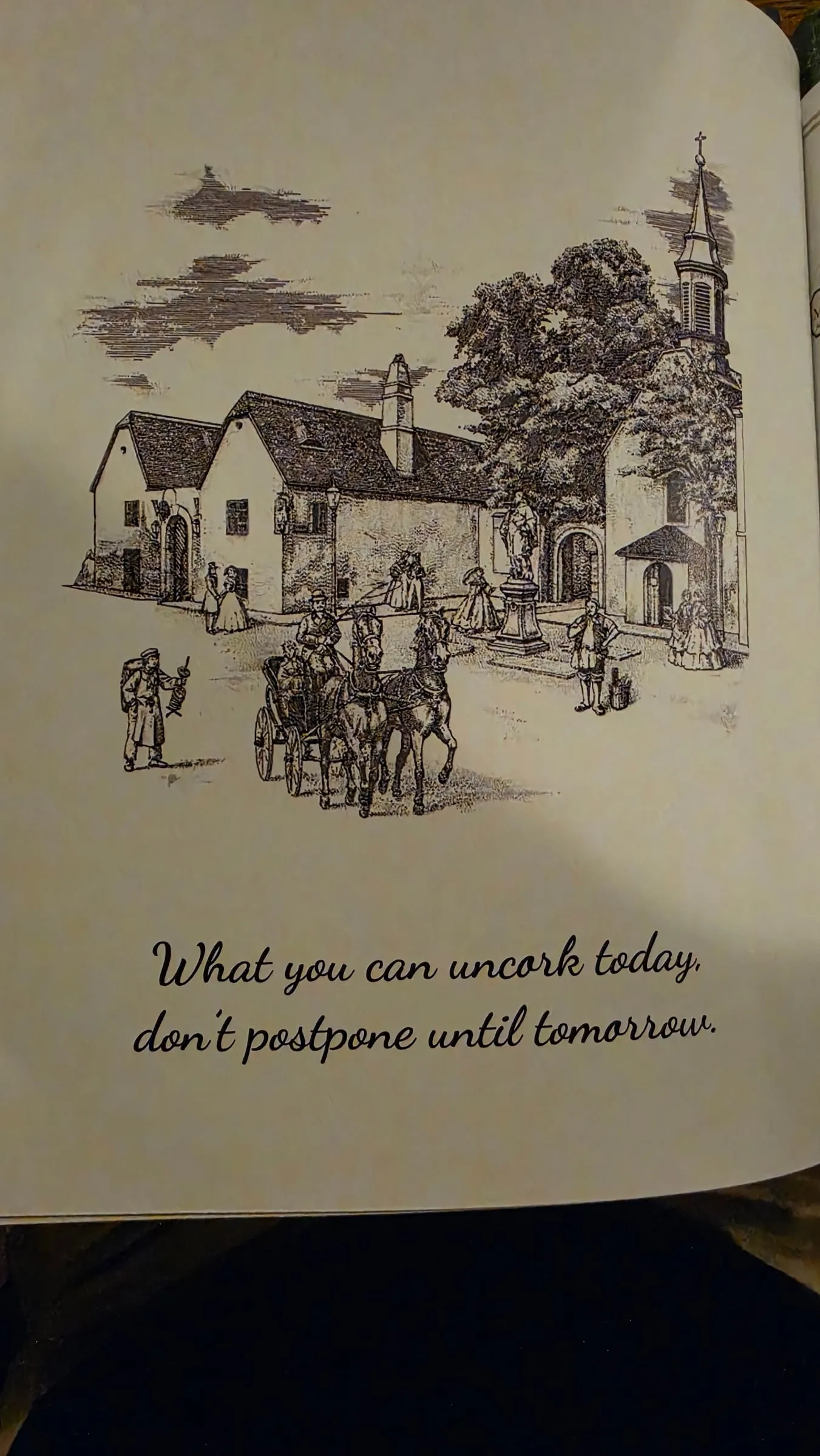
“What you can uncork today, don’t postpone until tomorrow.” A philosophy of life, printed on the menu.
Beyond Vienna
Klosterneuburg
Klosterneuburg Monastery was founded in 1114 by Margrave Leopold III and the Augustinian canons are still there. The monastery’s winery is the oldest in Austria. In the cellars, which go four storeys underground, stands the Tausendeimerfass from 1704 — a barrel holding 56,000 litres, which people have traditionally slid down on St. Leopold’s Day since 1813. Whoever makes it, they say, gets a wish granted. If you have more time, it is a full-day trip for wine, the biggest barrel and the monks. We had less time: we did not make it into the monastery, but the tour of the wine cellars with a tasting was perfect. In the shop the tasting was run by a woman from Brno, so we understood each other even without German.
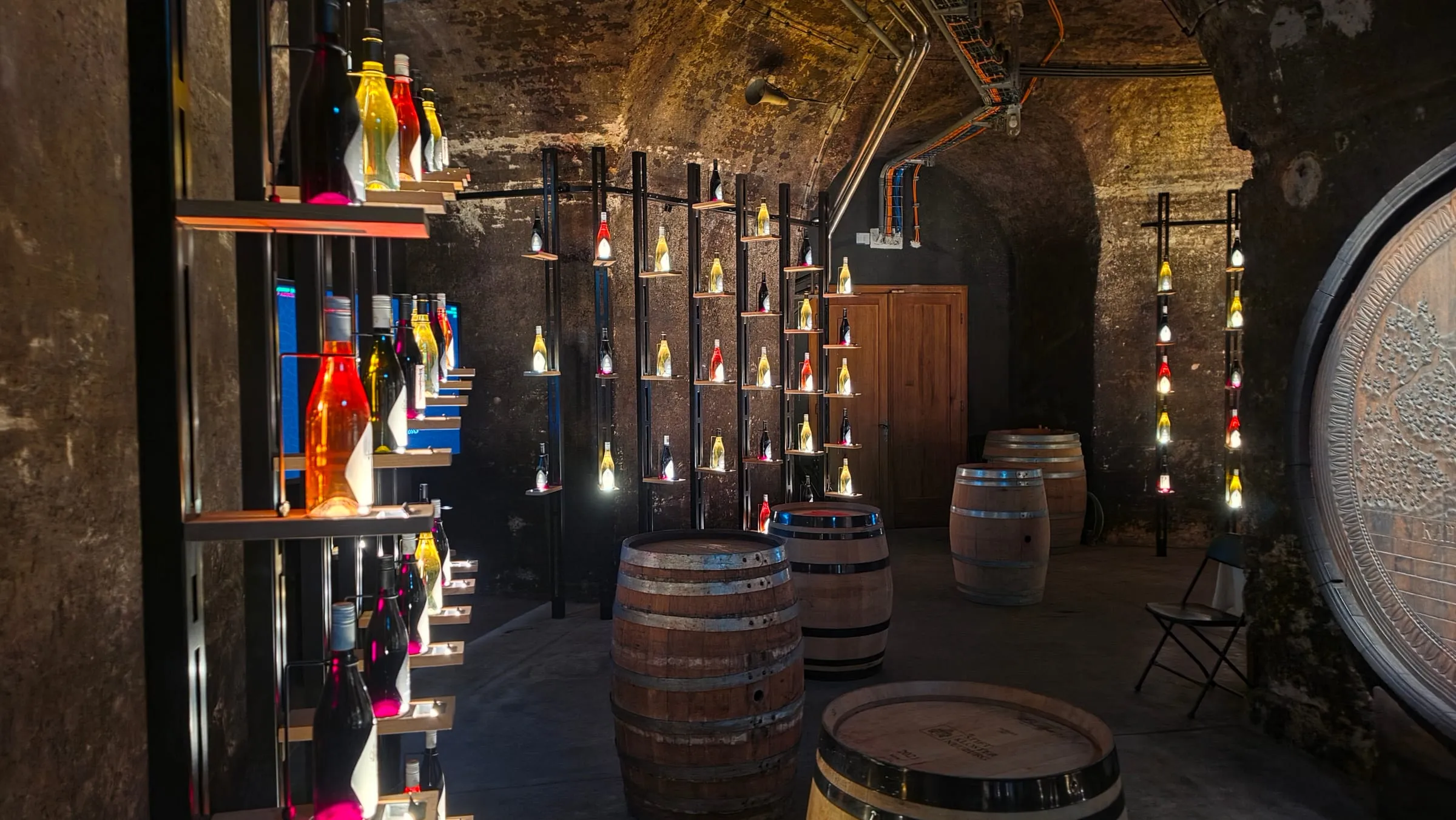
The cellars of Klosterneuburg. On the right, a piece of the big barrel.
Baden bei Wien
The spa town of Baden lies about 26 kilometres south of Vienna, lives off its sulphur springs and has been on the UNESCO list among the Great Spa Towns of Europe since 2021. Beethoven spent his summers here and worked on the Ninth Symphony. You can stay here — in December 2022 we stayed at the small Schloss Weikersdorf — and get into Vienna by historic tram: the Badner Bahn has run from Josefsplatz in Baden straight to the Vienna Opera since 1907, in about an hour. Spa, casino, Christmas Vienna within reach and peace in the evening.
Schloss Hof
The baroque estate in the Marchfeld was bought in 1725 by Prince Eugene of Savoy and later taken over by Maria Theresa. With its terraced garden it is the largest rural palace complex in Austria. It lies a few kilometres from the Slovak border — a cycle bridge across the Morava leads to Devínska Nová Ves — so it makes an ideal stop on the way home. We were there in December 2022, and cake in the palace café is part of the programme.
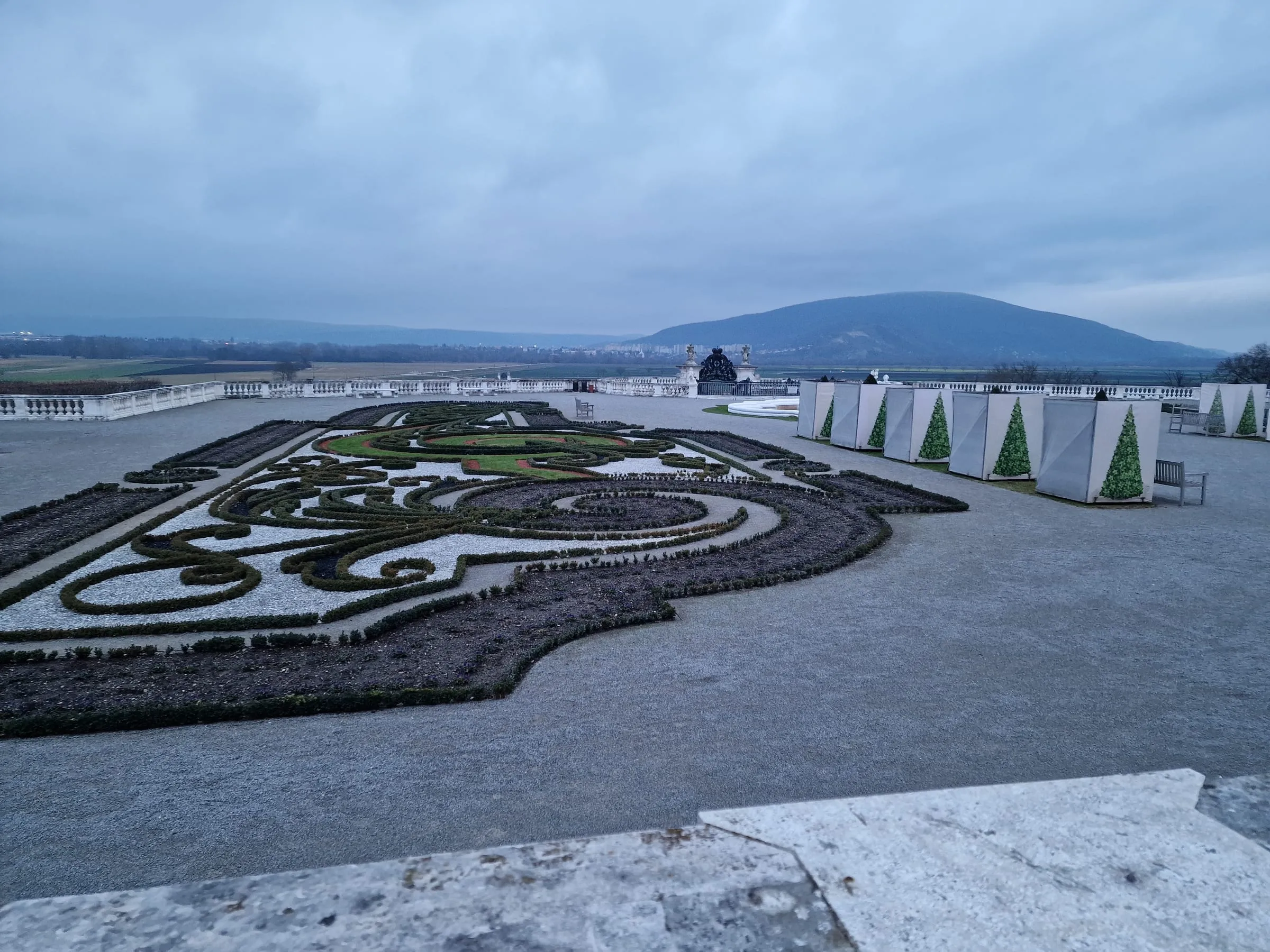
Schloss Hof, December 2022. Baroque in winter has an atmosphere of its own, especially when you have the terrace to yourself.
Schwechat airport
Flights from Bratislava are limited, so our flights leave from Vienna. The airport is about 18 kilometres south-east of the centre and just under 60 kilometres from Bratislava, handles more than thirty million passengers a year and the City Airport Train gets you downtown in 16 minutes. The Austrians know that people from Bratislava and Žilina fly from their airport. The car parks are priced accordingly.
Where to stay
Most recently Bob W Vienna Döbling, and it was a great place. We know Bob W from Copenhagen and Stockholm — it is an aparthotel chain with Finnish-Estonian roots dating from 2018 — and we will certainly go somewhere with them again. The Vienna one is next to the metro and the tram (Spittelau, U4 and tram D right to the door), there is a 24-hour Billa opposite (a petrol-station one, but 24-hour), the wine country is just outside the windows and parking costs six euros a day within ten minutes’ walk. In front of the entrance you can stop for fifteen minutes for free to unload. A short way off stands the Spittelau incinerator with its Hundertwasser façade from 1992 — Vienna can make even an incinerator pretty. Before that, in 2019 we stayed at the Hotel Rathauspark right next to the city hall and in 2022 in Baden, see above.
Food
Viennese cuisine is the cuisine of the monarchy and three dishes are compulsory: schnitzel, Tafelspitz and Kaiserschmarrn. Kaiserschmarrn is handled by Demel. For the rest there is Meissl & Schadn on Schubertring: a hotel and restaurant from 1896, once the mecca of Vienna’s beef eaters, destroyed by bombs in 1945 and back in business since 2017 in the Grand Ferdinand hotel. A true Wiener Schnitzel is, under the Austrian food code, veal only. The pork version may only be called “Viennese style”. Here they pound and fry it in front of you in an open kitchen. A superb schnitzel — I ordered it on the recommendation of a Slovak food show — and a huge Tafelspitz: boiled rump of beef, the dish that, according to a 1912 cookbook, was never missing from Franz Joseph’s table, with apple horseradish, chive sauce and fried potatoes.
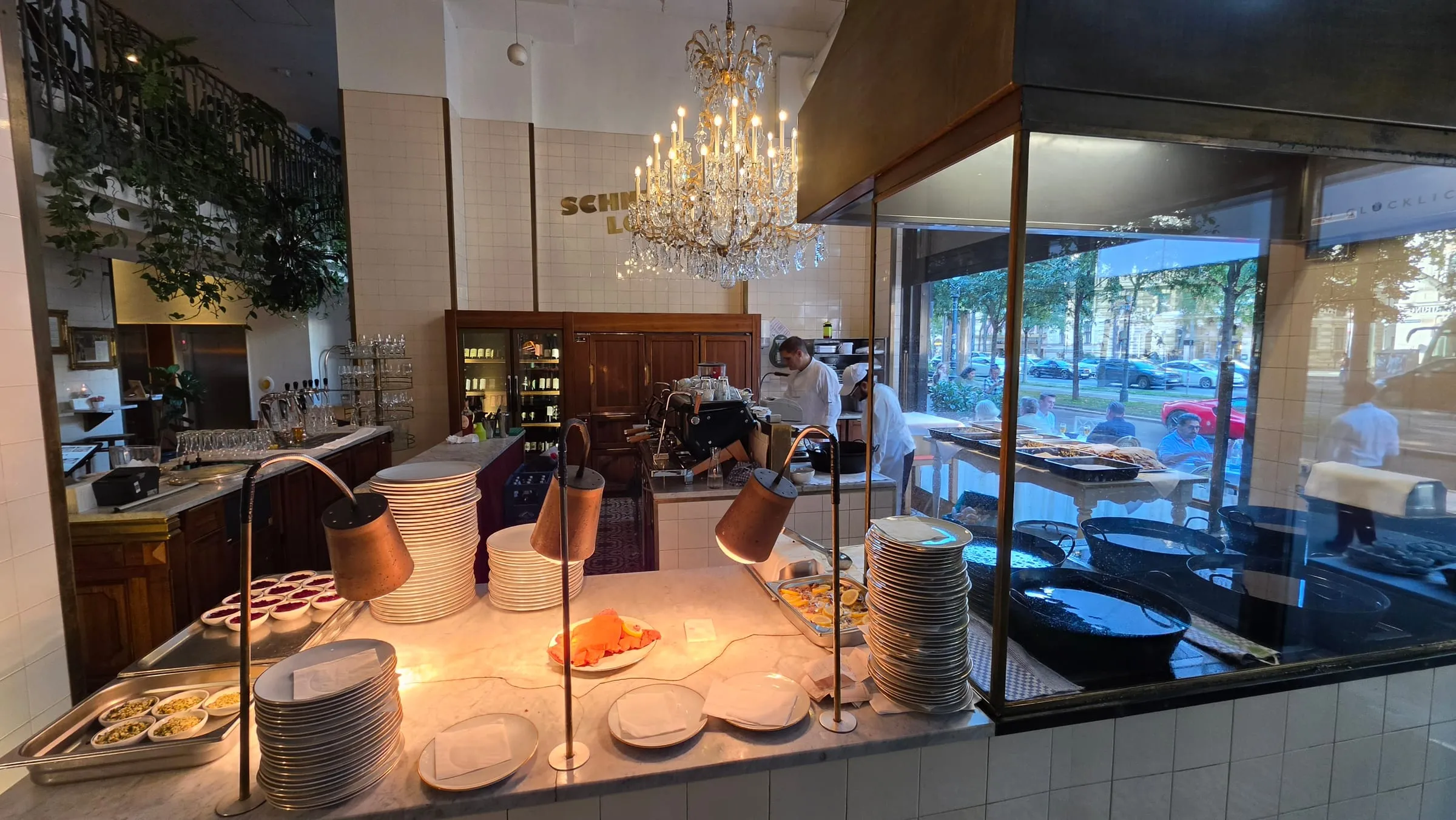
The Meissl & Schadn kitchen. The schnitzel is made in full view.
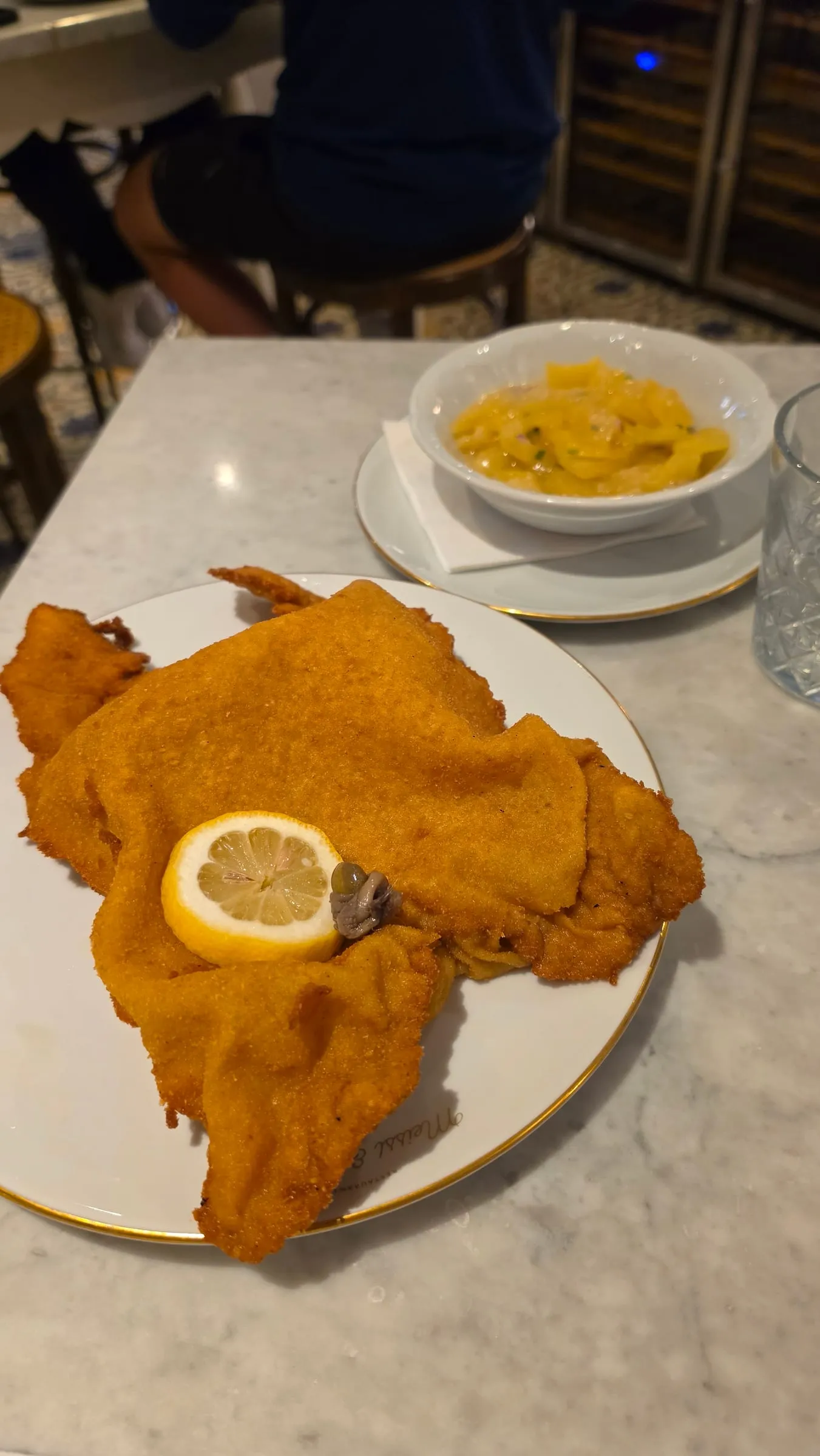
Wiener Schnitzel. The plate is indicative only.
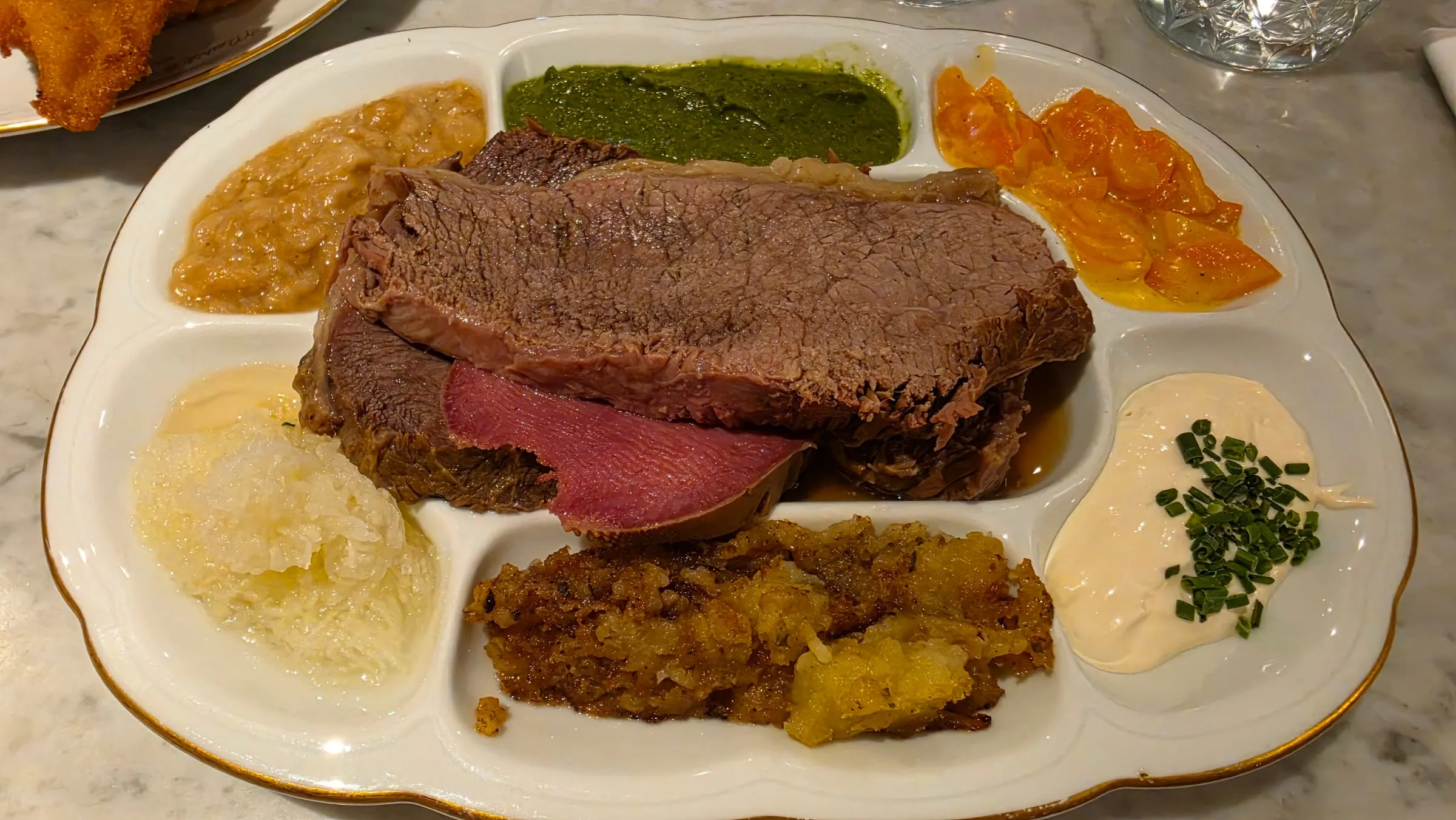
Tafelspitz with all the trimmings. The emperor knew what he was doing.
For a dinner with history there is the Griechenbeisl on Fleischmarkt — an inn documented since 1447, one of the oldest in Vienna. In the listed Mark Twain Room the walls and ceiling are covered with guests’ signatures — among them, supposedly, Mark Twain, Beethoven, Mozart, Schubert and Johann Strauss. The food is classic Viennese cooking in large portions. You feel like you are in a museum where eating is allowed.
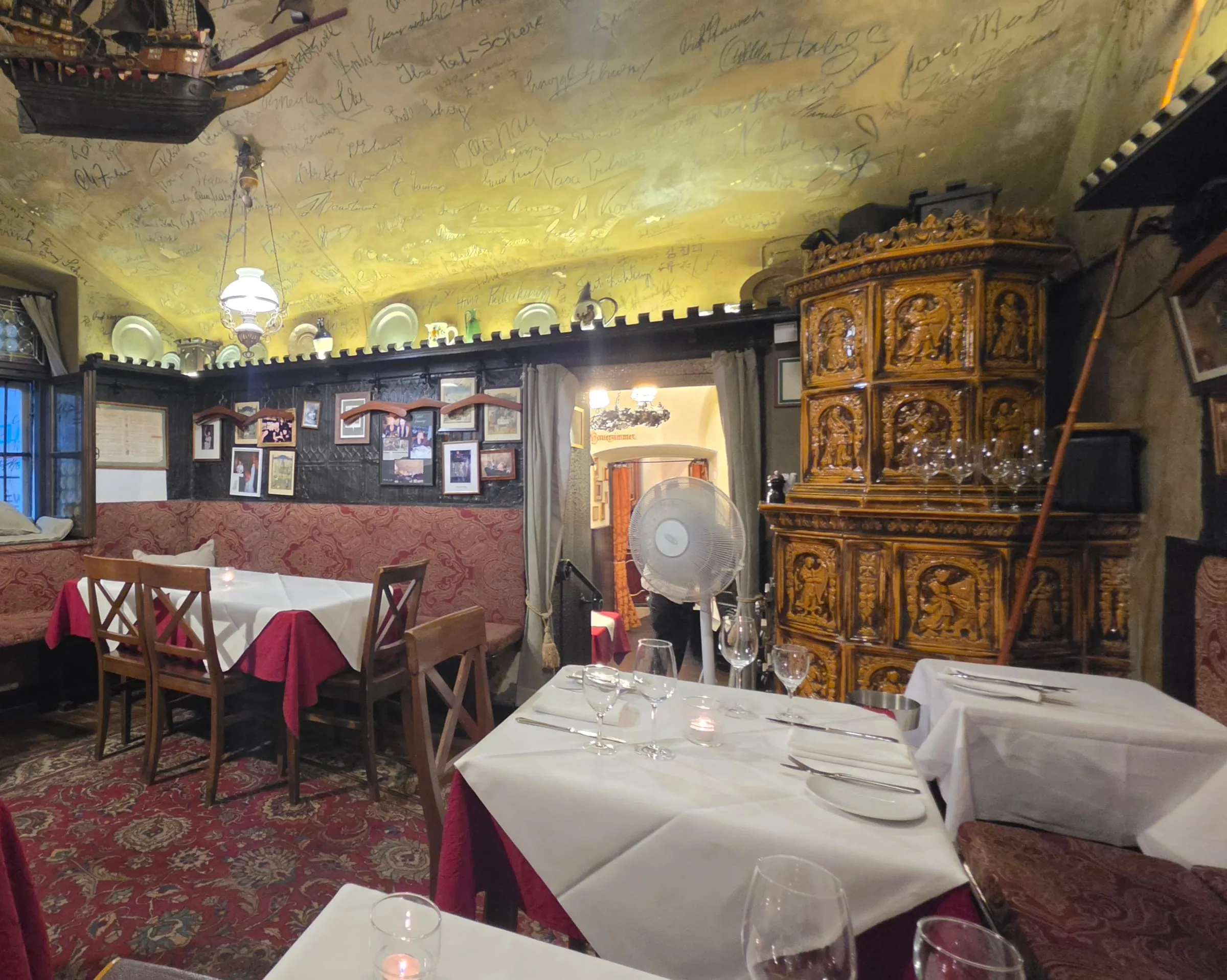
Griechenbeisl. Signatures up to the ceiling, Mark Twain somewhere among them.
And coffee. I do not drink it, but in Vienna I always order one — a Melange with the Kaiserschmarrn is part of the ritual, not a drink. Anyone who wants to go deeper can choose from Gerstner, Café Mozart, Hawelka or Sacher. We settled the café question with Demel.
What to bring home
Zotter chocolate from the Naschmarkt — a Styrian manufactory from Riegersburg, organic and fair trade, with flavour combinations that look like a joke until you taste them. Chocolates and delicacies from Meinl. Wine from Klosterneuburg, or from a Heuriger straight from Döbling. In September the young wine — Sturm in Austrian — from any Spar Gourmet. And once, near the city hall, we landed a Samsonite backpack at 80 percent off. That cannot be planned, but it can be remembered.
Not yet seen
The inside of Klosterneuburg Monastery, Verdun Altar included. The Belvedere, which was the first thing to drop out of the programme. The Schlumberger Kellerwelten, the sparkling-wine cellars literally opposite our apartment, which happened to be closed. The House of Strauss in Döbling, also closed. And the Kahlenberg with its view over the whole city — I have been planning that one since 2018.
Updated: September 2026 — first published, summary of the 2018–2026 trips.