Twenty years of systems for universities
Everyone who has applied to a Slovak university since 2011, and everyone who teaches or does research at one, is in the systems I work on. A short history of the registers and portals for higher education — from the first portal in 2005 to diploma verification in 2025.

When someone applies to a university today, they fill in one form on prihlaskavs.sk and send it to three schools at once. When they enrol, their name lands in the central register of students. Whoever teaches them is in the register of employees in turn — along with what they guarantee and what qualifications they hold. When a foreign student applies for a government scholarship or a Slovak-language lecturer leaves to teach at a university abroad, they go through another of these systems. And when our student graduates a few years later, an employer verifies their diploma on overdiplom.minedu.sk in half a minute. None of them sees what is behind it — and that is exactly how it should be. I have seen it for twenty years, because the University of Žilina builds these systems for the Ministry of Education and I lead its team for the central registers.
Why anyone should care
Because it concerns everyone who has studied, studies or will study — and just as much everyone who teaches or does research at a university. The state has one set of data about universities, not forty. From it it allocates money, produces statistics, can say how many people in Slovakia graduated in what and who guarantees which programme at which school. Universities do not report the same thing three times. And an applicant does not have to remember which school wants the application by post and which by e-mail.
It is also a project that shows what digital transformation really looks like — not on a conference slide, but in a twenty-year sequence of versions, directives, migrations and changes of the law.
Milestones
The illustration at the top has six milestones, the real timeline has more than twenty. Here it is in full, including what is still to come:
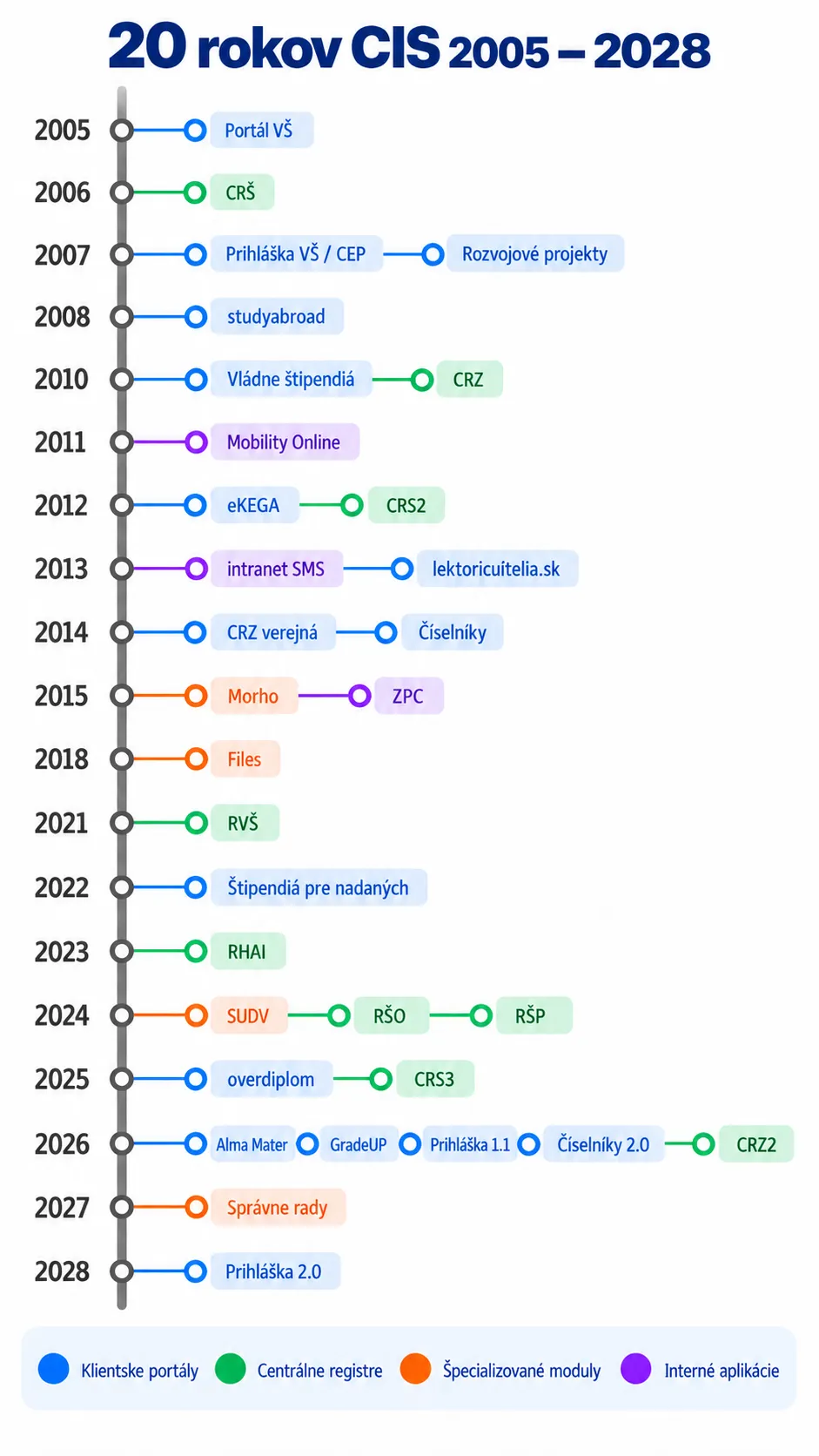
Twenty years of CIS on one axis. Blue are the portals people pass through, green the registers where the data lives, orange the specialised modules and purple the internal applications the public never sees. The last two rows are not history but a plan.
From the axis I pick the milestones that changed something and say what was behind them:
- 2005 — the Portál VŠ development project, proposed by the EUNIS-SK association and backed by the ministry. The University of Žilina was among the universities building it.
- 2006 — portalvs.sk goes live and is presented to the ministry. The same year, the first central register of students is born.
- 2007 – 2008 — the central electronic application is born, first as a project and then in pilot operation. Alongside it, the studyabroad system for study stays abroad.
- 2009 — the central register of students moves to the University of Žilina.
- 2010 — the register of employees is split off from the register of students, and the government scholarships for foreign students start.
- 2011 — the electronic application goes into full operation. Mobility Online arrives, the records of the stays abroad the ministry organises.
- 2012 — the systems move to the ministry’s data centre. eKEGA arrives, the electronic system for the KEGA grant agency and development projects, along with the second generation of the register of students.
- 2013 — lektoriucitelia.sk, applications of lecturers and teachers of Slovak for posts abroad.
- 2014 — the register of employees gets its public part, regzam.
- 2015 – 2016 — the module for accreditation decisions and the third version of Portál VŠ.
- 2021 — the register of higher education institutions.
- 2022 — talent scholarships.
- 2023 — the register of habilitations and inaugurations.
- 2024 — the registers of fields of study and study programmes, recognition of foreign qualifications and the application also via slovensko.sk.
- 2025 — CRŠ online, a fully online register of students, and diploma verification, which today is open to everyone with no login needed.
Four waves, if you want it simple. Foundations in 2005 to 2008, registers in 2009 to 2014, modules and a new portal version until 2016, and a new generation since 2021.
What of this is mine
Put simply — everything the ministry needs to know about what happens at universities, from students through teachers and researchers to scholarships and mobility, I do with the University of Žilina team and subcontractors. The one exception is publications, we do not do those. Specifically, the registers of students and employees, the register of institutions, scholarships and mobility are developed and run by the University of Žilina team that I lead. Portál VŠ and the application are led by the team of the Slovak University of Agriculture in Nitra, and I contribute to those. Studyabroad I once built as its manager from start to finish. Today a private company runs it under the same address and I no longer have anything to do with it.
Cards for the individual systems, with links to their public parts, are in the Projects section. This entry is their shared story and it will grow — every new milestone will be added here.
Updated: September 2026 — first published.