Fifteen years in 140 characters
In October 2011 my friends talked me into Twitter. I went through everything I wrote there in fifteen years — a time capsule of the internet, three topics that still drive me and a few predictions I'm glad I didn't bet on.

In October 2011 my friends talked me into Twitter. One of them, Peter Murár, wrote a whole book about it, Marketing na Twitteri. So I signed up too. The account was created on 9 October 2011 at 2.01 in the morning and forty-six minutes later I sent my first tweet. It was exactly what a first tweet tends to be — “so here I am :)”. A day later, again after midnight, came the confession “we have to drink to that :) you talked me into it”.
Since then I have written almost nine hundred posts and replies there. For the fifteenth anniversary I went through all of them, from the first to the last. I expected nostalgia. What I found was internet archaeology, three topics that still drive me and a few predictions I’m glad I didn’t bet on.
Why should anyone care
Because fifteen years of short notes turn out to be a surprisingly precise record of how the internet changed. And proof of how quickly it forgets. My first twenty tweets contain eight links. Five of them lead nowhere today.
A time capsule
The early years look like finds from another civilisation.
- “switch from Opera to Chrome complete :)” (June 2012). It reads like a note about moving house.
- “ICQ is close to my heart :P not giving it up that easily” (October 2012). ICQ has shut down since.
- “what is this raspberry pi? some kind of cake?” (January 2013).
- I shared photos through twitpic, shortened links with goo.gl and read reports about the Android Market. The Android Market became Google Play back in March 2012. Twitpic has not accepted new photos since 2014 and Google gradually switched off its shortener. In August 2025 all links that nobody was clicking any more stopped working.
- “after 7 years time for a new personal website :) looking for something easy…” (June 2012). That same night the new site was up at juraj.euniverzita.sk — a signpost to social and research networks, my last three tweets and a picture of my four most important projects. So I have had a personal website since 2005, and the page you are reading is its next generation. The old address now redirects here.
How my Twitter changed
At first it was status updates. Where I was, what surprised me, what was a #fail. Then came the years of sharing. In 2017 seven posts out of ten had a link, often to bitcoin news. And then it flipped. Since 2022 fewer than one post in ten has a link. The rest are short thoughts and quotations.
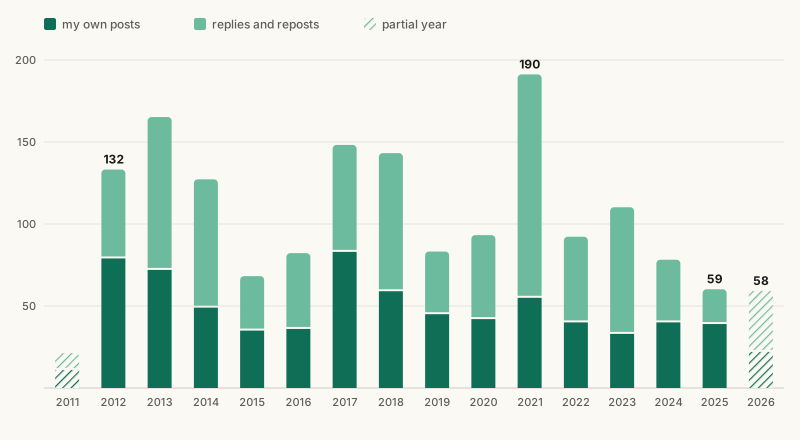
Tweets per year. The dark part is my own posts, the light part replies and reposts. Most of my own posts came in 2017, while the record year 2021 was made by reposts. 2011 starts on 9 October and 2026 ends on 30 September.
In the meantime Twitter doubled its limit from 140 to 280 characters in November 2017, Elon Musk bought it in October 2022 and in July 2023 he turned it into X. I almost stopped sharing links.
Three threads running through fifteen years

Three strings from one notebook. Bitcoin, universities and artificial intelligence are still what I write about here.
Bitcoin — from watching Mt. Gox fall to writing a paper about it
My first bitcoin tweet dates from June 2013. In February 2014 I followed the collapse of the Mt. Gox exchange as it happened, and in March I noted a new pronunciation I had picked up — “EmptyGox”. Nobody has put it more precisely.
In November 2017, next to a headline claiming bitcoin uses more energy than all of Slovakia, I promised “I have to calculate that some day :) trust but #verify”. In March 2018 came the line that sums it all up — you do not buy bitcoin, you sell euros.
And in September 2026 I shared our paper on X, in which my co-authors and I went through 21 bitcoin events from 2012 to 2024. Mt. Gox is among them. What I commented on as a fan in 2014, I analysed as a researcher twelve years later.
Universities
In October 2011 I wrote “The state of higher education from the employers’ point of view: a completely different kind of joy - sadness.” In February 2015 it was “Working hard on the new portalvs.sk :) measuring students” with eye tracking. I still work on those systems today, and the whole story is in the entry Twenty years of systems for universities.
One tweet from March 2019 is worth the whole thread, though. A cluster of students stood in the school lobby, debating whether to leave or stay a bit longer. It made me happy — who would not want to teach at a school students do not want to leave? “…and then it stopped raining.”
Algorithms and artificial intelligence
In June 2012 I noted “We live in the age of mathematics. The creators of computer algorithms hold enormous power. They decide whom we meet and what we learn.” Back then it sounded like a conference quote. Today it describes an ordinary day.
In September 2024 I wrote about mental muscles — just as people walk so their legs do not waste away, thinking needs exercise too before we hand part of the work over to GPT. In January 2025 came a warning — “Don’t trust fashion waves. Google used to be the expert, now it is Facebook and ChatGPT. Information is not knowledge.” In the original, the platforms get Slovak academic titles, engineer, master and doctor. And in July 2026 the line that artificial intelligence changes not only what we do but who we are. What ChatGPT can do in teaching is something we also studied in a paper.
What I claimed and how it turned out
The most entertaining part of an old account is the sentences about the future. Here is the tally, unvarnished.
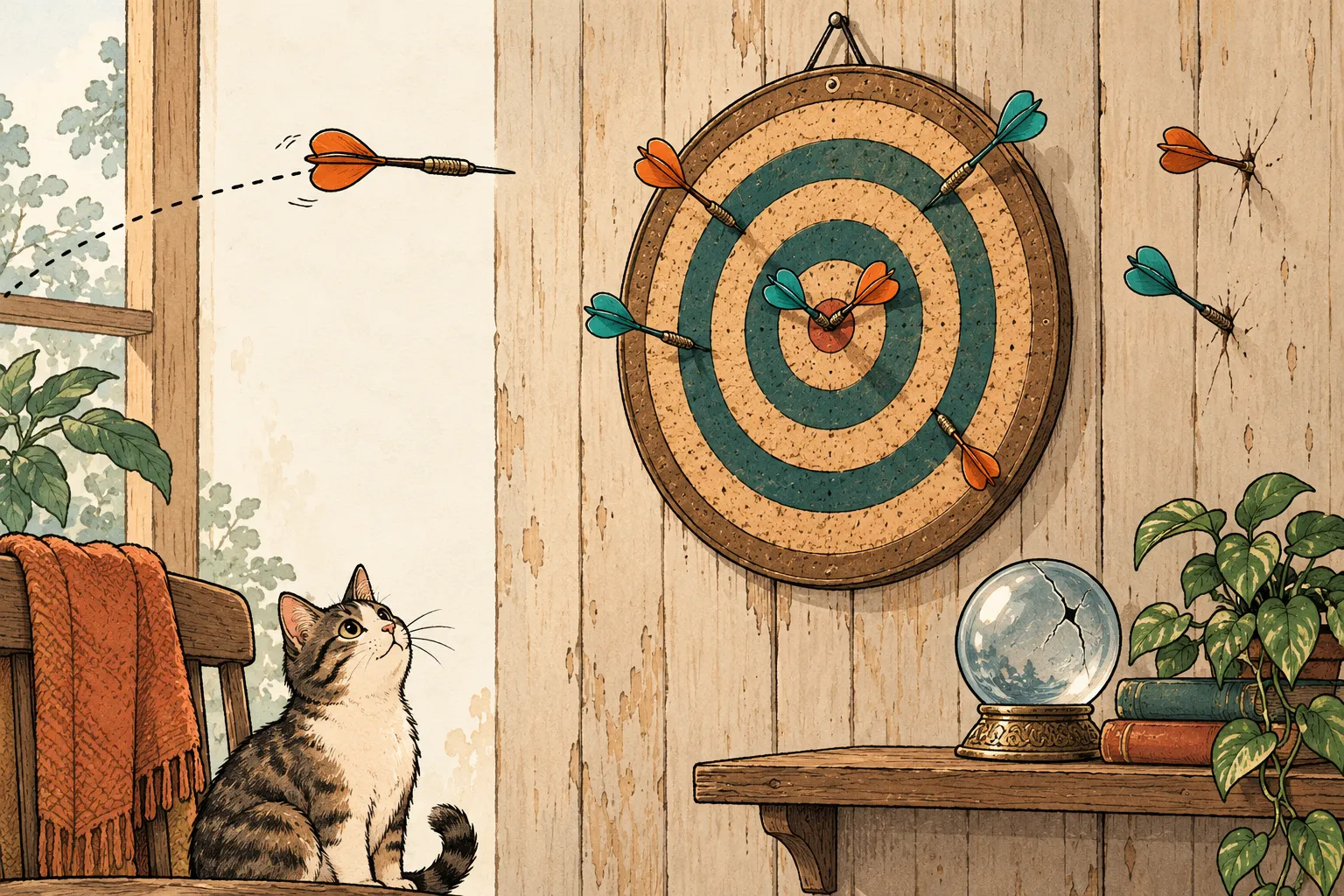
Nine predictions, nine darts. One is still in the air.
- Apple at a trillion (2012). I predicted that when Apple’s share hit 1,000 dollars, it would be the first company worth a trillion dollars. Apple reached that valuation on 2 August 2018, but its shares were trading at around 207 dollars, because Apple had split them seven for one in the meantime. And the world’s first was China’s PetroChina in 2007. Apple was the first in the US. Half a hit.
- HTC next in line (2012). I asked whether HTC was next after Nokia. In 2018 HTC sold Google part of the team that had worked on Pixel phones for 1.1 billion dollars. A hit, sadly. I carried an HTC in my pocket for years.
- NFC as the hit of 2013. You really can pay with your phone, but mass adoption came only a few years later. Apple Pay arrived in the US in October 2014, Google Pay in Slovakia in February 2018 and Apple Pay in June 2019. Right direction, wrong calendar. Half a hit.
- A bitcoin ETF (2014). “The first mutual fund focused on #bitcoin is one small step closer…” That small step took almost ten years. The US SEC rejected the Winklevoss fund in both 2017 and 2018 and only approved the first spot bitcoin ETFs on 10 January 2024. Half a hit, right direction, wrong timing.
- Bitcoin as gold, not money (2017). When Steam stopped accepting bitcoin in December 2017 over high fees and price swings, I wrote that it would become gold rather than money. That prediction has no date, so I am letting it run. Still open.
- Starlink as the backbone of the internet by 2024 (2019). It did not happen. Starlink keeps growing, but according to TeleGeography more than 99% of intercontinental data still flows through undersea cables. A miss.
- The bet on Google courses (2021). I claimed that in a few years nobody would know about them, but universities would still be here. Universities are still here. So are the Google courses — by May 2025, according to Google, more than a million people had completed them. Half a hit.
- The video call (2023). I wrote that from 2023 on you could no longer trust even a video call. In January 2024 an employee of the Hong Kong branch of the firm Arup sent fraudsters about 25 million dollars after a video call featuring deepfake versions of his bosses. A hit I am not proud of.
- Students and prompts (2024). Commenting on Gemini in Google Docs, I wrote that it would take a while before students learned to write prompts. A year later the British HEPI survey found that 92% of university students use artificial intelligence. Whether they can write prompts, the survey did not measure. But they started using it far faster than I expected. A miss.
Two clean hits, four halves, two misses and one still open. Decent for an internet commentator. Weak for a fortune teller.
Why I write here now
Twitter is a note in the margin. Quick, short and — as most of my first links show — temporary. In fifteen years the platform changed its name, its owner and its rules, and nobody asked me about any of it. That is why I now write the longer things here, on my own domain.
By the way, in October 2015 I bought a single share of Twitter Inc. through Degiro. “#musthave”. In October 2022 Elon Musk bought Twitter for 54.20 dollars a share and a few days later the company disappeared from the stock exchange. I am still here.
Updated: October 2026 — first published.
This text reflects my personal view and serves educational purposes. It is not investment advice.